

Turning Off the Noise and Finding Peace in the Paint: How Creativity Became My Anchor
By Shannon Ratcliffe
Somewhere along the way, life gets loud.
Motherhood, work, relationships, responsibilities—it all fills your mind in a way that rarely leaves space for stillness. For years, I lived in that constant motion. Always doing, solving, connecting. Always available, always needed, always moving toward the next thing. But rarely slowing down. Rarely asking myself what I actually needed.
The world doesn’t make it easy to stop. We’re rewarded for productivity, celebrated for busyness, and quietly conditioned to believe that rest is something we have to earn. So we keep going—until we forget what it felt like to just be.
Art changed that for me.
When I paint, everything quiets. I often say it’s my way of “turning my brain off,” but it’s more than that—it’s coming back to the present. The brush, the color, the movement. Nothing else matters in that moment. There are no deadlines on a canvas. No notifications. No one needing anything. Just me, and whatever I’m making. And in a world that rarely pauses, that feeling is everything.
Science actually backs this up. Studies have shown that engaging in creative activities lowers cortisol levels, reduces anxiety, and activates the same restorative mental state as meditation. But I didn’t need a study to tell me what I already felt in my body—the exhale that happens the moment I pick up a brush.
Art has always been a part of me. As an only child, I spent hours creating—drawing, building kites, even turning old Coca-Cola cans into little sculptures. It was never about being perfect or producing something impressive. It was about making something from nothing. About the joy of the process itself.
But life moved on, and art took a back seat.
I built a career, raised my girls, showed up for everyone else. Creativity still showed up in small ways—birthday signs, costumes, thoughtful details—but it wasn’t central to my life anymore. I had quietly traded the things that filled me for the things that filled everyone else.
Until everything shifted.
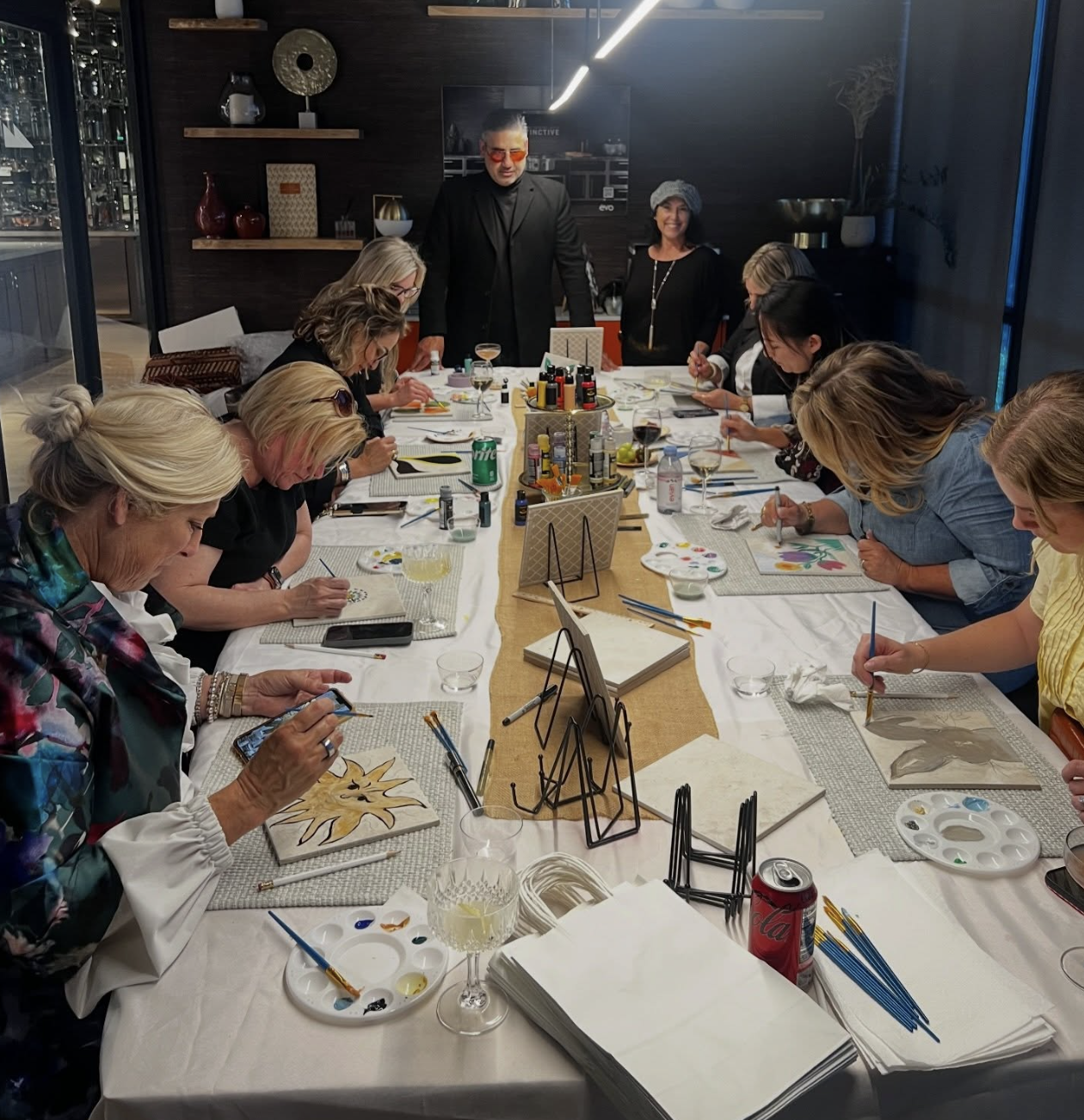
In a season where I was rebuilding and learning to slow down, I picked up a paintbrush again—almost by accident. What started as simple signage turned into something much bigger. Painting grounded me in a way I hadn’t felt in years. It reminded me that I was still in there—underneath the roles and the routines and the responsibilities.
Now, I can’t stop.
From transforming old surfboards into art to painting murals that bring life to blank walls, I’ve found a creative rhythm that feels both energizing and calming at the same time. There’s something deeply powerful about taking something old—or empty—and turning it into something meaningful. It mirrors, in a way, what creativity does for us internally. It takes the worn-out, the overlooked, the forgotten parts of ourselves—and breathes new life into them.
What I didn’t expect was how much I needed this.
Even on hard days—especially on hard days—painting brings me back to center. It’s become my therapy, my reset, my way of reconnecting with myself when the noise of life has drowned out my own voice. It doesn’t require perfection. It doesn’t require an audience. It just requires showing up and being willing to make something.
As the artist and author Julia Cameron wrote in The Artist’s Way: “Creativity is the natural order of life. Life is energy: pure creative energy.” That resonates with me deeply. Creativity isn’t a luxury or a hobby reserved for “artistic people.” It’s something woven into all of us—and when we cut ourselves off from it, we lose access to something essential.
And maybe that’s the beauty of returning to it—realizing that the things we loved as kids don’t disappear. They just wait for us to return. Patiently. Without judgment. Ready to welcome us back the moment we’re willing to show up.
For me, art isn’t just something I do anymore.
It’s where I find peace.
5 Tips for Returning to a Creative Practice (Even When Life Is Full)
1. Start smaller than you think you need to. You don’t need a dedicated studio, a full afternoon, or the perfect supplies to begin. Fifteen minutes and a set of watercolors on the kitchen table count. The goal isn’t a masterpiece—it’s a moment. Lower the bar so far that starting becomes effortless, and let momentum build from there.
2. Protect it like an appointment. Creativity is one of the first things we sacrifice when schedules get tight—because it feels optional. But treat your creative time the way you’d treat a meeting you can’t move. Put it on the calendar. Tell your family it’s happening. Show up for yourself the way you show up for everyone else.
3. Release the pressure to be “good.” One of the biggest reasons adults abandon creative outlets is the fear of not being talented enough. But that’s not the point. The point is the process—the quieting, the presence, the release. Give yourself full permission to make things that are messy, imperfect, and just for you.
4. Let old interests lead you back. Think about what you loved to do as a child—before anyone told you whether you were good at it or not. Drawing, dancing, building, writing, playing music. Those early instincts are worth revisiting. They often point directly toward the kind of creativity that will feel most natural and most nourishing to you now.
5. Notice how you feel after, not during. Creative flow doesn’t always feel effortless in the moment—sometimes starting is awkward, and the first few minutes feel forced. But pay attention to how you feel when you’re done. If you feel calmer, lighter, or more like yourself, that’s your signal. That’s the practice worth returning to.