

I Don’t Hit the Ground Running on Mondays Anymore
On Labor Day, maybe the real question isn’t how hard we work. Maybe it’s why we’ve become so uncomfortable when we’re not working.
There is something almost comical about publishing this on Labor Day, a national holiday meant, at least in theory, to honor work by stepping away from it. And yet I’d be willing to bet that by some time this afternoon, millions of people will already be mentally leaving the holiday. Checking tomorrow’s calendar. Thinking about the inbox. Planning the week. Preparing themselves to “hit the ground running.”
We are remarkably good at turning a day off into preparation for going back to work.
I know because I’ve done it too.
Recently, I had a strange reaction to Monday. I rebelled against it. Not against work. Not against ambition. Not because I’ve suddenly decided achievement is overrated or that the answer to a meaningful life is to do less, expect less and spend my remaining years wandering around in white linen pants contemplating the horizon.
Although, to be fair, linen pants still have their appeal even in white past labor day.
What I rebelled against was the script.
Monday morning. Hit the ground running. Get ahead. Clear the inbox. Make the calls. Attack the week.
Attack the week?!?!
Think about that language for a second…
Somewhere along the way, we decided Monday was something to survive, dominate or defeat. And like everyone else, I learned the choreography. Wake up. Accelerate. Prove you’re serious.
Except this particular Monday, I caught myself…
Halfway through the day, I realized I was behaving as though somebody had sounded an alarm! Only nobody had. There was no emergency, no crisis, no one standing over me demanding that everything move faster. There was just me, moving fast because somewhere inside me I had absorbed the idea that Monday required speed. Monday demanded I hit the ground running.
So I asked myself a ridiculously simple question: Why am I in such a hurry?
And the answer was slightly embarrassing…Because I had decided I should be!
Most of the deadlines were mine. Most of the expectations were mine. Most of the urgency was mine. I had created the pressure and then started reacting to it as though it had been imposed on me.
That’s ridiculous!! And more importantly, turns out it’s also optional.
That realization stopped me cold, because over the last year I’ve spent a lot of time thinking about what it means to design a life on my own terms. Apparently I had redesigned the businesses, the calendar, the projects, the relationships, the travel, the interests…but somehow Monday morning had escaped renovation.
So I changed it.
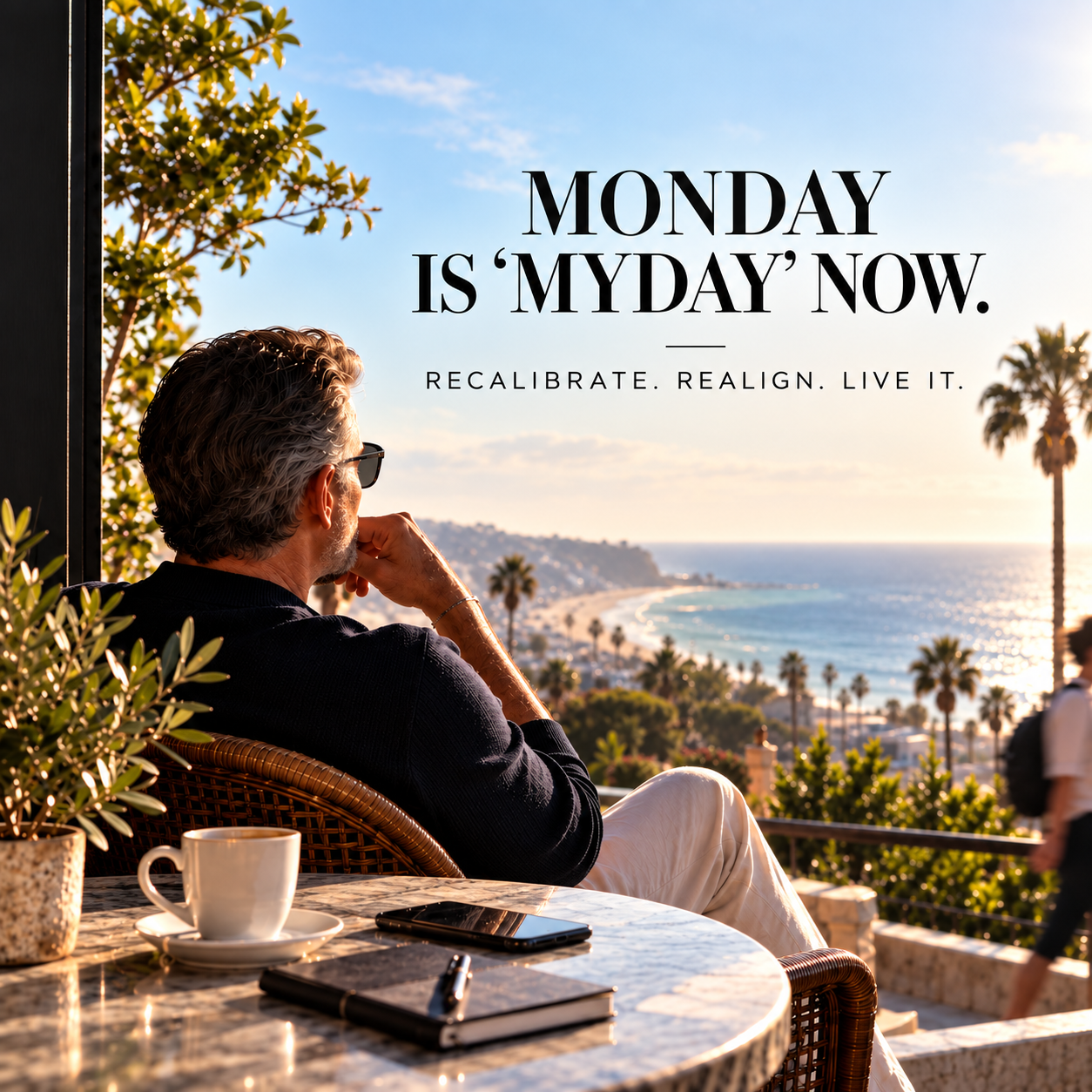
Monday is now Myday.
Not “my day off.” Not “self-care Monday.” God forbid.
It is My Recalibration Monday.
Monday now is the day I decide what the week deserves from me before the week starts taking things. I may work. I may write. I may meet people. I may exercise. I may change course entirely. But I am no longer willing to wake up and automatically surrender my nervous system to a day of the week.
That’s the part I’m done with. And once I saw that, I started seeing the same pattern everywhere.
We have become addicted to optimization. Sleep. Food. Exercise. Work. Money. Travel. Relationships. Longevity. Apparently even relaxing now requires a strategy!
I say this as someone who is absolutely guilty of it. I track things. I train. I care about longevity. I like performance. I like getting better.
But there is a point where improvement becomes its own form of captivity.
At some point, you have to ask whether you’re improving your life or simply managing it more aggressively.
That question interests me more now, because I think a lot of successful people have quietly built very sophisticated prisons. The prison has a nice house. The prison has good wine. The prison flies business class. The prison has a trainer. The prison has a smartwatch. The prison has a beautiful calendar filled with things you chose.
And somehow you’re still anxious on Sunday night.
That should tell us something.
We’ve become incredibly skilled at taking freedom and turning it back into obligation. You spend years trying to gain more control over your time, then once you finally get it, you fill every inch of it. Meetings. Metrics. Commitments. Workouts. Goals. Targets. Plans.
Then you wonder why life still feels crowded.
Maybe because you rebuilt the cage yourself.
That line bothers me because I know I’ve done it.
I’ve been ambitious most of my adult life. I still am. Actually, I think I’m more ambitious now than I was before. The difference is that I’m no longer convinced ambition has to look frantic.
When I was younger, ambition looked like speed. More. Faster. Next.
Now I think ambition can also look like depth. Staying in the conversation longer. Following an idea because it interests you rather than because it monetizes. Letting curiosity mess up your schedule. Doing something simply because it makes you feel alive.
That should not be as radical as it sounds. But somehow it is.
We have gotten so good at extracting value from everything that even rest starts to feel suspicious unless it accomplishes something. Take the walk, count the steps. Read the book, turn it into content. Have the dinner, photograph it. Travel, document it. Sleep, score it. Relax, optimize it.
Good God! Can anything just simply ‘happen’ anymore?
Some of the best moments of my life have been wildly inefficient. A ridiculous conversation. A dog doing something stupid. Three olives at the bottom of a martini. A song I forgot existed. Sitting at a table long after everyone should have gone home with someone I really care about and whose company I simply enjoy.
Those moments accomplished nothing metrics measurable which may be precisely why they mattered.
I care about longevity. I want strength, energy, mobility and years. But I’ve become increasingly suspicious of the idea that more years is the ultimate victory.
What exactly are the extra years for?
More appointments? More optimization? More metrics?
I don’t just want more life expectancy. I want more life, more aliveness even, in my life.
And perhaps that’s why Sunday should matter more going forward too.
Think about how much of Sunday we quietly give away in advance. Somewhere late in the afternoon around 3:45, the atmosphere changes. And Tomorrow comes crashing in… Check the calendar. Prep the meals. Think about work. Review the inbox. Mentally leave the weekend.
We call that responsibility…maybe it is. Although, maybe it’s just that we’re just starting to prematurely pay Monday rent with Sunday.
I’m done doing that. Monday can handle Monday.
And here’s the part that surprised me most: when I stopped creating artificial urgency for myself, the people around me seemed less stressed too.
Of course they did.
Urgency is contagious.
If I decide everything is urgent, eventually everyone around me lives inside my urgency. My self-imposed deadline becomes their emergency. My anxiety becomes their workload. My Monday morning energy becomes someone else’s Sunday night dread.
That is not leadership. That is emotional outsourcing.
Yes, I have done that too and I’m trying to be better about it.
I still expect a lot. I like high standards. I like momentum. I like people who care. But I no longer believe tension is proof that something important is happening. I no longer believe speed automatically means commitment. And I definitely don’t believe exhaustion deserves the status symbol we’ve given it.
Busy is not a personality.
Stress is not a credential.
A packed calendar is not evidence of significance.
We’ve made frantic living look impressive. Maybe it isn’t. Maybe it’s just bad design.
That is why Labor Day feels like the right day to have this conversation. Because Labor Day should probably be about more than taking one Monday off. Maybe it should make us ask what our relationship with work actually is.
Not whether we work hard. Hard work has built extraordinary things. It has built companies, families, careers, cities, discoveries and lives. I’m not interested in demeaning that.
I’m interested in whether work has quietly expanded beyond its rightful borders.
Whether achievement has become identity. Whether productivity has become morality. Whether being busy has become proof that we matter. And whether we still know how to stop without feeling guilty.
Because there is a difference between being driven and being chased by your own manufactured urgencies.
I spent a lot of years assuming they were the same thing. They’re not.
Being driven has energy in it. Being chased has fear in it. Being driven feels expansive. Being chased feels narrow. Being driven creates. Being chased reacts. And I know which one I want now.
And yes, I recognize the privilege in saying I can choose how I structure Monday, and that not everyone can do so.
But if you can, and you still refuse to use that freedom because some invisible social script tells you successful people are supposed to be frantic, that’s worth examining don’t you think?
After all what exactly was/is all the work for?
To earn freedom, no? Or was it to become so conditioned to pressure that you no longer know what to do without it?
That question has teeth and the answer should be blatantly obvious.
So this article is not a productivity hack. It’s not a four-day-workweek manifesto. It’s not permission to become less ambitious. It’s a refusal to remain obedient to urgency when urgency has no legitimate claim on me.
That’s different.
Maybe the real luxury isn’t working less. Maybe it’s deciding what deserves urgency and what doesn’t.
Maybe it’s owning your pace. Knowing when to sprint, when to wander, when to push, when to sit, and being secure enough not to apologize for any of it.
So yes, on this Labor Day, I’m taking Monday back.
But Monday is not really the point. The point is that I’m becoming much less interested in living according to rules I never consciously agreed to.
So I will keep asking myself one question and ask you to do the same:
Who decided this has to be done this way?
Sometimes there is a good answer. Fine.
But sometimes the answer is habit, expectation, ego, fear or simply: That’s what successful people do.
That answer no longer impresses me.
So I rebel a little and invite you to do too.
Leave something inefficient. Waste an afternoon. Let dinner run late. Ignore the metrics. Cancel something that never needed to exist. Stop turning every hour into an asset that needs to perform.
And perhaps, on a holiday created to honor labor, remember something we seem to have forgotten:
You are more than the work you produce!
So now I’m curious… what’s one rule about work, productivity or success that you’ve been following without ever consciously deciding it was yours?
And if you’re willing to rebel against it, even a little, what would you do differently?
Freedom, always,
Raad Ghantous
ABOUT RAAD GHANTOUS:
Raad Ghantous is a designer by trade and a reinvention architect by choice. Raised internationally and shaped by decades in hospitality and residential design, he now leads The Raad Life — a platform for seasoned leaders who refuse to coast into midlife quietly. Through media, live gatherings, and curated collaborations, Raad explores identity after success and the freedom to consciously design your next chapter.